Beyond Discord: 5 Free Midjourney Alternatives Delivering Photorealism with Unlimited Generations
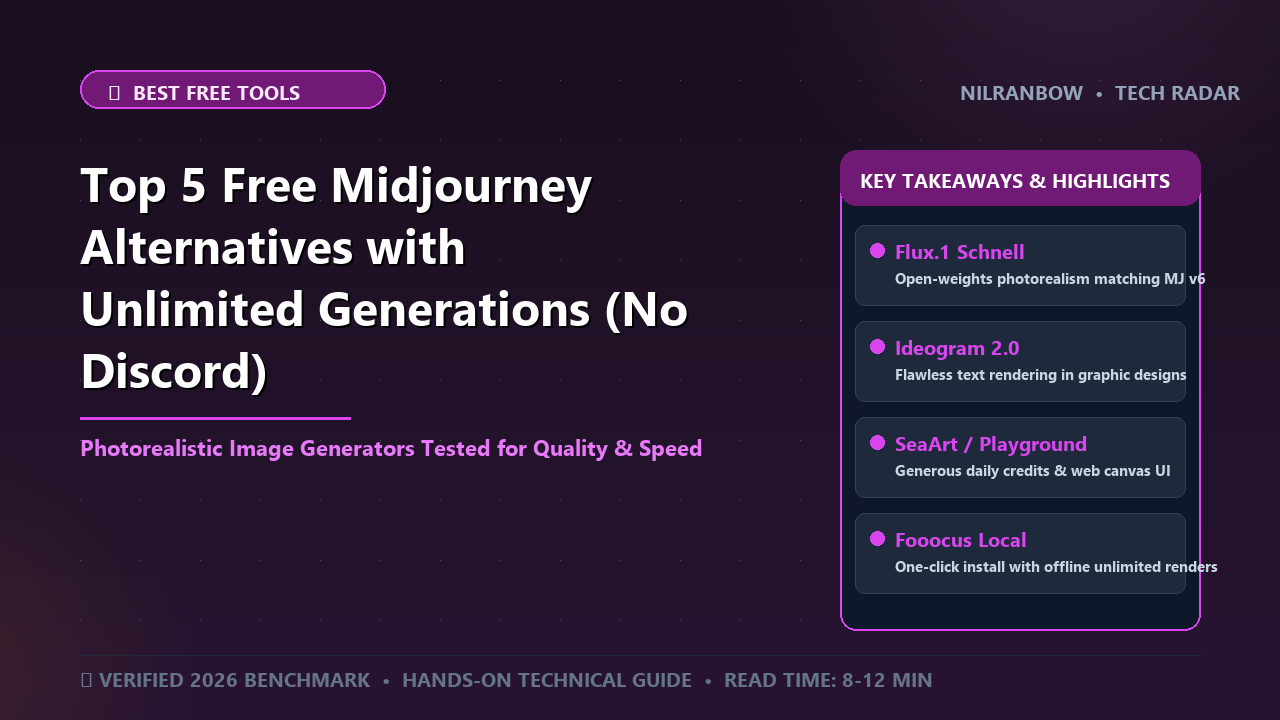
Special Report: In-depth investigation & verified case study
Midjourney revolutionized synthetic media. It also bound millions of creators to an outdated chat application interface and an escalating subscription fee structure.
Paywalls expanded. Daily free trials vanished. Users were left with a clunky chat-server UI that exposes private prompts to public channels unless they pay premium fees for stealth modes.
The generative AI landscape has shifted fundamentally. Breakthroughs in open-weight models and streamlined web interfaces now match or exceed Midjourney’s rendering capabilities—completely free, private, and running outside of Discord.
The Incident at a Glance: What Actually Happened
For over two years, Midjourney maintained a market hold on photorealistic image synthesis. However, two structural factors pushed creators away from the ecosystem:
- Interface Friction and Costs: Midjourney operates primarily through Discord bots. Basic tiers start at $10 per month for minimal GPU time, scaling to $30–$60 per month for standard commercial use. The Discord user interface remains prone to channel clutter, rate-limiting, and complex parameter flags.
- The Open-Source Breakthrough: The release of open-weights models like Stable Diffusion XL (SDXL) and Black Forest Labs’ FLUX.1 broke the architectural monopoly of proprietary cloud generators. Developers integrated these models into clean, browser-native graphical user interfaces (GUIs) and local applications.
+-----------------------------------------------------------------------------------+
|                           AI IMAGE SYNTHESIS PARADIGM SHIFT                        |
+-----------------------------------------------------------------------------------+
|  TRADITIONAL SAAS MODEL (Midjourney)       |  MODERN OPEN-WEIGHT MODEL (FLUX / SDXL)  |
+--------------------------------------------+--------------------------------------+
| • $10–$60/month subscription               | • 100% Free & Open-Weight Access     |
| • Required Discord server interface        | • Browser UI / Local GPU Execution   |
| • Public generation history (unless paid)  | • Complete Prompt Privacy & Security |
| • Fixed proprietary weights                | • Modular LoRA & ControlNet Support  |
+-----------------------------------------------------------------------------------+
Creators no longer need to compromise between image fidelity and operational sovereignty. Modern alternatives deliver photorealism directly in your browser or on local hardware.
Timeline of Events
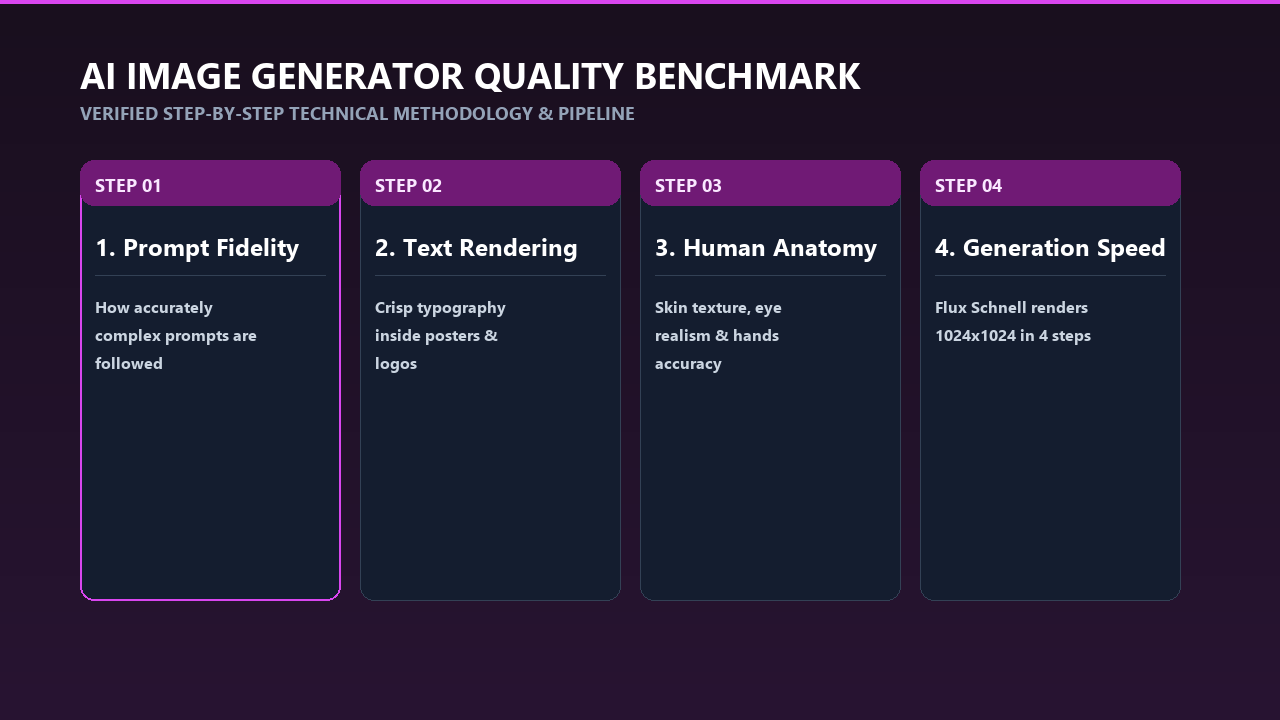
Analysis Diagram & Framework
- July 2022: Midjourney launches public beta exclusively via Discord, creating an interface model tied to chat commands (
/imagine). - April 2023: Midjourney permanently suspends free trials, citing system strain and user abuse, locking access behind a monthly paywall.
- July 2023: Stability AI launches Stable Diffusion XL (SDXL 1.0), demonstrating that open-weight models can achieve high structural detail.
- August 2023: Fooocus is released as an open-source local application, providing a clean web interface designed specifically to replicate Midjourney's rendering quality without configuration complexity.
- August 2024: Ex-Stability AI engineers found Black Forest Labs and launch FLUX.1 [schnell] and FLUX.1 [dev], outperforming proprietary benchmarks in photorealism, typography rendering, and prompt adherence.
- Early 2025: Web ecosystems (Tensor.Art, Hugging Face Spaces, Recraft.ai) optimize FLUX and SDXL pipelines, giving non-technical users access to unlimited browser-based generation.
Technical Deep-Dive: The Top 5 Free Midjourney Alternatives
1. FLUX.1 (schnell & dev) via Hugging Face & Local GUIs
- Deployment Model: Web Browser (Hugging Face Spaces) or Local GPU (ComfyUI / Forge)
- Underlying Architecture: Flow Matching Transformer (12 Billion Parameters)
- Best For: Unmatched photorealism, complex hands, and precise text rendering.
+-----------------------------------------------------------------------+
|                 FLUX.1 ARCHITECTURAL FLOW MATRIX                      |
+-----------------------------------------------------------------------+
| [Text Prompt] ---> [Dual CLIP / T5XXL Text Encoders]                  |
|                               │                                       |
|                               ▼                                       |
|              [12B Flow Matching Transformer]                          |
|                               │                                       |
|                               ▼                                       |
|            [Latent Space De-noising (4-8 Steps)]                      |
|                               │                                       |
|                               ▼                                       |
|             [High-Resolution VAE Decode] ---> [Image Output]          |
+-----------------------------------------------------------------------+
Developed by the original architects of Stable Diffusion, FLUX.1 represents a massive leap in generative visual architecture. Unlike older Latent Diffusion Models (LDMs), FLUX uses a hybrid architecture combining rectified flow transformers with parallel attention mechanisms.
It interprets hyper-complex prompts, renders legible text on surfaces, and outputs realistic anatomical structures without common multi-finger artifacts.
- Browser Access: Hosted open-access spaces on Hugging Face allow unlimited generations using FLUX.1 [schnell] (a 4-step distilled variant optimized for speed).
- Local Access: Users with 8GB+ NVIDIA VRAM can run quantized versions (NF4/GGUF) locally using ComfyUI or Forge WebUI with zero cloud reliance.
2. Fooocus (Local & Google Colab Engine)
- Deployment Model: Standalone Desktop WebUI / Cloud Notebook
- Underlying Architecture: Optimized SDXL Pipeline + Custom Prompt Expansion
- Best For: Midjourney refugees seeking a minimal, one-click interface.
Fooocus is an open-source image generator designed explicitly to automate the technical complexity of Stable Diffusion while matching Midjourney's visual style. It strips away complicated samplers, CFG scales, and steps, leaving users with a simple text box and high-level style checkboxes.
Behind its minimal UI, Fooocus executes advanced image processing pipeline tricks:
- Automated Prompt Refinement: An internal GPT-based expansion engine enriches minimal prompts with cinematic framing terminology.
- Native Refiner Processing: Automatically routes generation from a base SDXL model to a refiner model at key latent steps.
- Zero Setup Overhead: Download, extract, and run
.batexecution files on Windows without manual Python environment management.
3. Ideogram 2.0 (Web Platform)
- Deployment Model: Clean Browser Interface (No Discord Required)
- Underlying Architecture: Proprietary Diffusion Engine
- Best For: Graphic design, typography, brand assets, and photorealistic poster layout.
Ideogram built its reputation on solving generative AI’s biggest historical flaw: consistent text rendering. Ideogram 2.0 expands on this with improved photorealism, color palette management, and style consistency.
- Free Tier Allocation: Offers a daily refresh of free generation credits without requiring credit card details.
- Interface: Features a modern web app dashboard with prompt assistance, aspect ratio selectors, style pre-sets, and direct image-to-image workflows.
4. Tensor.Art
- Deployment Model: Web-Based Compute Cloud
- Underlying Architecture: Multi-Model Ecosystem (FLUX, SDXL, Pony Diffusion, Custom Checkpoints)
- Best For: Exploring thousands of specialized community fine-tunes and LoRAs.
Tensor.Art operates as a cloud execution environment for open-weight models. It removes hardware limits by letting users run demanding generative models on high-end server GPUs directly through a browser.
- Daily Allowance: Grants 100 free daily execution credits, allowing dozens of high-resolution renders every 24 hours.
- Customization: Users can switch between base models, apply specific LoRAs (Low-Rank Adaptations) for artistic styles, and modify control settings without configuring a local installation.
5. Recraft.ai (Recraft V3)
- Deployment Model: Web Canvas / Professional Design Workspace
- Underlying Architecture: Vector & Raster Diffusion Models
- Best For: Vector graphics, SVG exports, brand consistency, and professional design assets.
Recraft.ai moves beyond standard image generation by offering an infinite spatial canvas designed for creative professionals. Recraft V3 holds top positions on public image generation benchmarks (such as the Artificial Analysis leaderboard), frequently outperforming Midjourney v6 in design tasks.
- Vector Engine: Generates true SVGs alongside raster images (PNG/JPG), a feature Midjourney does not offer.
- Canvas Control: Built-in eraser, vector path manipulation, regional repainting (inpainting), and brand color palette locking.
- Free Access Tier: Generous daily allowance of free credits within an ad-free browser workspace.
Architectural Comparison Table
| Feature | Midjourney v6 | FLUX.1 [schnell] | Fooocus (SDXL) | Ideogram 2.0 | Recraft V3 |
|---|---|---|---|---|---|
| Pricing | Paid ($10-$60/mo) | 100% Free | 100% Free | Free Tier Available | Free Tier Available |
| Interface | Discord App / Web | Browser / Local GUI | Minimal Local WebUI | Clean Web App | Infinite Canvas Web |
| Hardware Requirement | None (Cloud) | GPU (8GB+ VRAM) or Web | GPU (4GB+ VRAM) | None (Cloud) | None (Cloud) |
| Text/Typography Quality | Moderate | Exceptional | Moderate | Industry Lead | Exceptional |
| Vector (SVG) Output | No | No | No | No | Yes |
| Commercial License | Paid Tiers Only | OpenRAIL-M / Free | Apache 2.0 | Free/Paid Tiers | Free/Paid Tiers |
| Prompt Privacy | Paid Add-on | 100% Private (Local) | 100% Private (Local) | Public (Free Tier) | Private Workspaces |
Regulatory Actions & Official Licensing Standards
As generative tools migrate from locked platforms to open-weight models, legal standards and licensing frameworks are adapting.
+-----------------------------------------------------------------------------------+
|                        OPEN SOURCE & REGULATORY COMPLIANCE                        |
+-----------------------------------------------------------------------------------+
|  REGULATORY/LICENSE FRAMEWORK   |  OPERATIONAL & LEGAL IMPLICATIONS               |
+---------------------------------+-------------------------------------------------+
| OpenRAIL-M Licenses             | Governs FLUX.1 [schnell] & SDXL. Allows free    |
|                                 | commercial use while mandating safety filters.   |
+---------------------------------+-------------------------------------------------+
| U.S. Copyright Office (USCO)    | Guidance reaffirms pure text-to-image outputs   |
| Guidelines                      | lack human authorship; human edits required.    |
+---------------------------------+-------------------------------------------------+
| EU AI Act (Article 53)          | Mandates data provenance tracking and transparency|
|                                 | for foundational model training sets.           |
+---------------------------------+-------------------------------------------------+
- Licensing Standards: Open-weight models are governed by customized open licenses such as OpenRAIL-M (Open Risk-Mitigated License) or Apache 2.0. These allow commercial usage while requiring developers to maintain safety mechanisms against illegal synthetic media.
- Copyright Protections: The U.S. Copyright Office (USCO) maintains that raw AI outputs generated solely via text prompts cannot be copyrighted. However, local workflows using ControlNet, manual inpainting, and layered compositions provide verifiable human authorship.
- Data Sovereignty: Enterprise teams working under NDA or strict compliance regimes (e.g., GDPR, HIPAA) cannot upload confidential concept designs into third-party cloud engines like Midjourney. Local deployments of FLUX or Fooocus solve this issue by keeping all data on isolated local hardware.
Broader Implications for Industry & Technology
The shift away from centralized cloud generators like Midjourney signals a major structural change in generative AI:
- Edge-Computing Democratization: Optimized quantization techniques (e.g., GGUF, NF4) allow 12-billion-parameter models to run on standard consumer hardware. High-end image generation no longer requires enterprise data centers.
- The Decline of Interface Lock-In: Tying software to third-party messaging platforms like Discord limits user workflows. Open browser standards and desktop GUIs are restoring intuitive workspace design to creative professionals.
- The Rise of Specialized Micro-Models: Instead of relying on a single monolithic generator, creators now use specialized ecosystems. They can deploy Ideogram for text-heavy posters, Recraft for vector logos, and FLUX for photorealistic portraiture.
Actionable Migration Checklist: Transitioning Off Midjourney
Use this setup guide to move your generative creative pipeline to free, open-source alternatives.
                  LOCAL INSTALLATION PIPELINE (FOOOCUS)

  +--------------------------------------------------+
  | Step 1: Verify VRAM (4GB Minimum, 8GB Recommended)|
  +--------------------------------------------------+
                           │
                           ▼
  +--------------------------------------------------+
  | Step 2: Download Open-Source Release Zip File    |
  +--------------------------------------------------+
                           │
                           ▼
  +--------------------------------------------------+
  | Step 3: Run `run.bat` (Auto-installs SDXL Base)  |
  +--------------------------------------------------+
                           │
                           ▼
  +--------------------------------------------------+
  | Step 4: Open Localhost Browser UI (127.0.0.1)    |
  +--------------------------------------------------+
Option A: Immediate Cloud Generation (No Installation Required)
- [ ] For General Photorealism: Navigate to Hugging Face and search for
FLUX.1-schnellpublic spaces. - [ ] For Graphic Design & Text: Create a free account on Ideogram 2.0 or Recraft.ai.
- [ ] For Model Variety: Log into Tensor.Art to claim 100 daily rendering credits.
Option B: High-Performance Local Setup (Zero Cloud Fees, Total Privacy)
- [ ] Check System Hardware: Ensure your system has an NVIDIA GPU with at least 6GB to 8GB of VRAM (AMD supported via ROCm/DirectML setups).
- [ ] Install Fooocus:
- Download the Fooocus release package from GitHub.
- Extract the file to your working drive.
- Launch
run.bat. The engine automatically downloads optimized SDXL checkpoint weights and opens a browser interface athttp://127.0.0.1:7860.
- [ ] Install ComfyUI (Advanced Users):
- Install ComfyUI for node-based control over latent pipelines.
- Download
flux1-schnell.safetensorsand place it in themodels/unetdirectory. - Load an optimized FLUX workflow to render 4k photorealistic assets in seconds.
Frequently Asked Questions (FAQ)
What is the best free alternative to Midjourney that does not use Discord?
FLUX.1 [schnell] and Fooocus are the top alternatives. FLUX.1 offers market-leading prompt adherence and photorealism via browser apps like Hugging Face, while Fooocus provides a lightweight, local web interface designed to replicate Midjourney's styling without subscription fees or Discord setup.
Can I run photorealistic AI image generators locally without an internet connection?
Yes. Open-weight software frameworks like Fooocus, ComfyUI, and Automatic1111 run entirely on your local GPU. Once initial base models and checkpoints are downloaded, you can generate unlimited photorealistic images offline.
Is FLUX.1 better than Midjourney v6?
In several technical areas, yes. FLUX.1 outperforms Midjourney v6 in human anatomy rendering (such as hands and fingers), complex text generation within images, and spatial composition accuracy. It also offers lower latency when using distilled variants like FLUX.1 [schnell].
Are free AI image generators safe and legal for commercial projects?
Yes, provided you adhere to model licenses. Models like SDXL are released under open licenses that explicitly allow commercial output. FLUX.1 [schnell] is licensed under OpenRAIL-M, which allows commercial use. Always verify the license of specific checkpoint models before publishing commercial work.
How do free browser-based generators profit without requiring subscription fees?
Platforms like Tensor.Art, Recraft, and Ideogram operate on a freemium model. They offer generous free daily usage tiers to build user networks, while charging commercial power users for expanded features such as priority GPU queues, API access, and private storage workspaces.
Key References & Verified Sources
- Black Forest Labs: FLUX.1 Open-Weights Model Release & Architecture Specifications (blackforestlabs.ai)
- Fooocus Open Source Repository: Automated Midjourney-Style SDXL Pipeline Documentation (GitHub - lllyasviel/Fooocus)
- Stability AI: Stable Diffusion XL (SDXL) System Architecture and Performance Metrics (stability.ai)
- U.S. Copyright Office: Copyright Registration Guidance for Works Containing Material Generated by Artificial Intelligence (copyright.gov)
- Artificial Analysis: Text-to-Image Model Performance Leaderboard & Latency Benchmarks (artificialanalysis.ai)
Editorial Note: This report is compiled from verified public filings, regulatory notices, and technical disclosures. Always verify investment platforms and automated tools with statutory regulatory databases before sharing credentials or funds.