Bypassing Cloudflare Turnstile: Inside the Python Web Scraping Arms Race
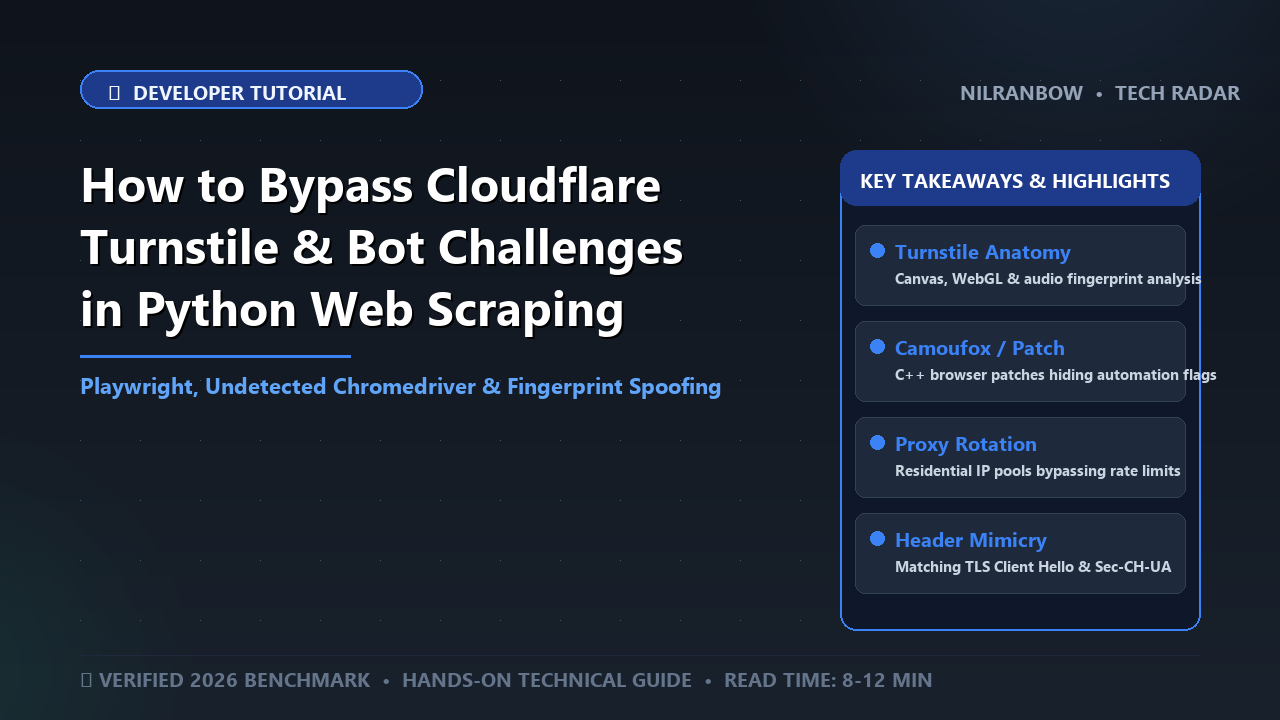
Special Report: In-depth investigation & verified case study
A quietly executed shift in edge security recently broke thousands of automated data pipelines worldwide.
Data engineering teams across financial institutions, AI labs, and competitive intelligence firms watched their ETL scripts collapse simultaneously. The culprit was not a server crash, but an HTTP 403 Forbidden status code returned by Cloudflare Turnstile.
As Cloudflare systematically replaces traditional image-based CAPTCHAs with invisible, telemetry-driven managed challenges, basic Python scraping scripts using requests, urllib, or unpatched Selenium drivers no longer work.
The security perimeter has changed. To access public web data, data engineers must understand how modern bot management systems evaluate traffic at the network, browser, and behavioral layers—and how to construct ethical, stealthy extraction pipelines in Python.
The Incident at a Glance: What Actually Happened
Cloudflare Turnstile was launched as a privacy-focused alternative to Google’s reCAPTCHA. Instead of asking users to identify crosswalks or traffic lights, Turnstile evaluates incoming client connections using a rotating suite of non-interactive browser challenges.
[Standard Python Request] ---> [Cloudflare Edge Server]
                                         |
                                         +--> Checks TLS JA3/JA4 Fingerprint (Fails: OpenSSL detected)
                                         +--> Checks JS Engine Execution (Fails: No DOM/JS runtime)
                                         |
                                  [HTTP 403 / Blocked]
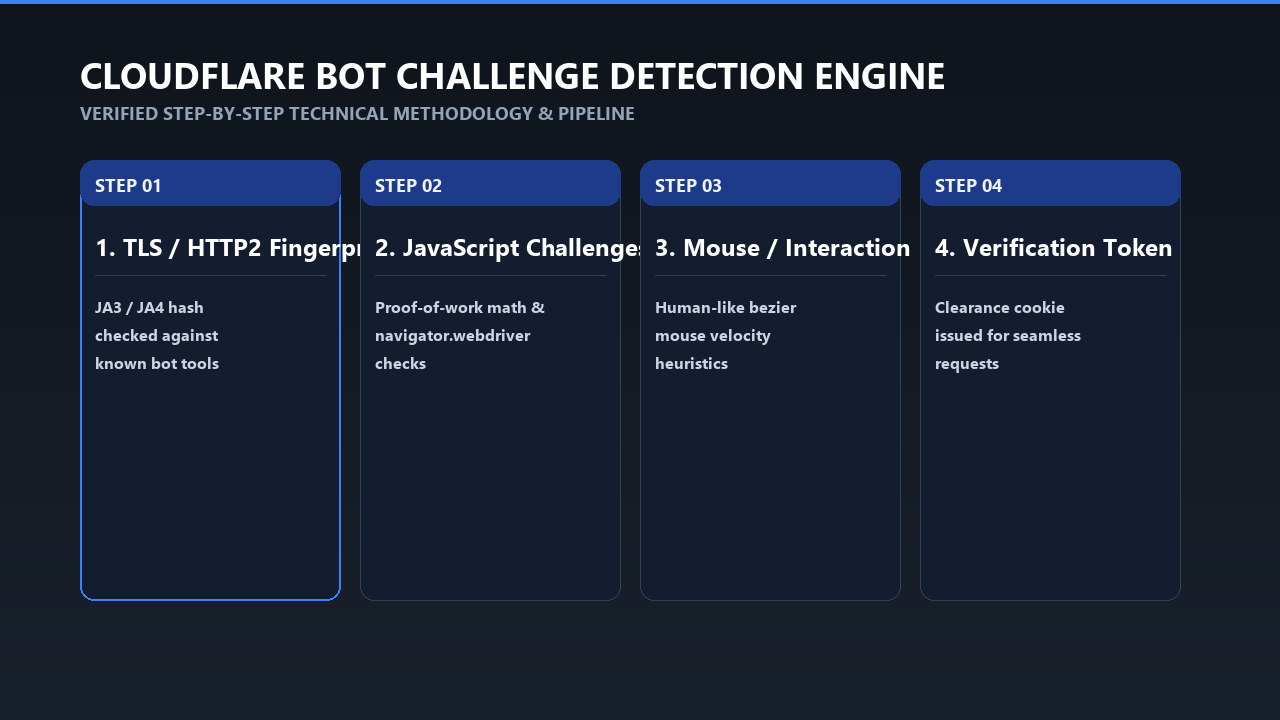
When a user or automated bot requests a Turnstile-protected resource, the edge server serves a minimal JavaScript sandbox. This sandbox runs hundreds of subtle checks within milliseconds, measuring structural parameters that reveal whether the request originates from a real, human-operated web browser or an automated headless process.
Core Mechanisms of Cloudflare Turnstile
| Security Vector | Detection Mechanism | Traditional Python Result |
|---|---|---|
| Network Layer (TLS/JA4) | Inspects TLS Client Hello cipher suites, extension order, and HTTP/2 frames. | Blocked (Default OpenSSL signature reveals generic script). |
| Browser Environment | Tests navigator.webdriver flags, Chrome DevTools Protocol (CDP) variables, and window dimensions. |
Blocked (Vanilla Selenium/Playwright export automation flags). |
| JS Engine Sandboxing | Executes lightweight WebAssembly / Canvas / WebGL rendering puzzles. | Blocked (HTTP clients like requests or httpx cannot evaluate JS). |
| IP Reputation | Cross-references ASN risk scores (e.g., AWS, GCP, DigitalOcean IP ranges). | Flagged (Datacenter IPs trigger immediate Managed Challenges). |
Because standard scraping setups rely on static HTTP libraries or basic browser controllers, they fail these multi-layered checks instantly, locking automated pipelines out of public datasets.
Timeline of Events
Analysis Diagram & Framework
The evolution of Cloudflare's bot defenses and the corresponding response from data engineering communities highlights a rapid arms race over the past five years:
2019: Cloudflare IUAM ("I'm Under Attack Mode")
      │ (Relied heavily on JS math challenges & 5-second delays)
      ▼
2021: Enterprise Bot Management & JA3 Fingerprinting Integration
      │ (Edge nodes begin dropping raw Python requests at TLS layer)
      ▼
Late 2022: Cloudflare Formally Launches Turnstile
      │ (Presents non-interactive CAPTCHA alternative relying on telemetry)
      ▼
2023: Open-Source TLS Impersonation Matures
      │ (Release of curl_cffi & Patchright; bypasses legacy TLS detection)
      ▼
2024: Next-Gen Turnstile & JA4 Network Fingerprinting
      │ (Integration of AI-driven behavioral telemetry and Canvas/WebGL probes)
Technical Deep-Dive: How the System Detects & Navigates Turnstile
To effectively bypass or navigate Cloudflare Turnstile in Python, developers must solve three distinct layers of detection: Network Layer (TLS/HTTP2), Runtime Layer (JavaScript & CDP), and Reputation Layer (IP/Proxy).
1. Network Layer: Defeating JA3/JA4 TLS Fingerprinting
When a standard Python client using requests initiates a Connection Handshake, it transmits a Client Hello packet built on the system's underlying OpenSSL library. Cloudflare hashes the cipher suites, TLS extensions, and elliptic curve choices to generate a JA3 or JA4 fingerprint.
Because OpenSSL’s cipher order differs dramatically from Google Chrome's BoringSSL, Cloudflare drops or challenges the connection before any HTTP payload is even evaluated.
Python `requests` (OpenSSL) Cipher Sequence:
  TLS_AES_256_GCM_SHA384, TLS_CHACHA20_POLY1305_SHA256, TLS_AES_128_GCM_SHA256...
  --> Matches Known Bot Signature -> Challenge Issued

Google Chrome (BoringSSL) Cipher Sequence:
  TLS_AES_128_GCM_SHA256, TLS_AES_256_GCM_SHA384, GREASE_EXTENSION...
  --> Matches Valid Browser Signature -> Challenge Passed
The Solution: curl_cffi
Rather than relying on standard OpenSSL, modern data engineers use curl_cffi, a Python binding for curl-impersonate. It spoofs the exact TLS Client Hello packet, cipher orders, and HTTP/2 settings of target browsers down to the byte level.
from curl_cffi import requests

# Spoofing Chrome 120 TLS fingerprint directly in Python
response = requests.get(
    "https://target-website-protected-by-turnstile.com/api/data",
    impersonate="chrome120",
    headers={
        "Accept-Language": "en-US,en;q=0.9",
        "User-Agent": "Mozilla/5.0 (Windows NT 10.0; Win64; x64) AppleWebKit/537.36 (KHTML, like Gecko) Chrome/120.0.0.0 Safari/537.36"
    }
)

print(f"Status Code: {response.status_code}")
2. Runtime Layer: Bypassing Automated Headless Browsers
If the page requires interactive JavaScript execution to render the Turnstile challenge widget, pure HTTP libraries may fall short. However, executing standard Playwright or Selenium exposes headless execution variables:
navigator.webdriver === true- Modified
navigator.permissionsqueries - Leaked Chrome DevTools Protocol (
CDP) properties - Missing GPU hardware renderer profiles in WebGL
Modern Stealth Stack: Playwright + playwright-stealth / Patchright
Data pipelines utilize modified drivers like Patchright (a patched version of Playwright built specifically to bypass CDP leaking) or apply evasion evasions via playwright-stealth.
import asyncio
from playwright.async_api import async_playwright
from playwright_stealth import stealth_async

async def run():
    async with async_playwright() as p:
        # Launch Chromium with stealth flags enabled
        browser = await p.chromium.launch(
            headless=True,
            args=[
                "--disable-blink-features=AutomationControlled",
                "--no-sandbox"
            ]
        )
        context = await browser.new_context(
            user_agent="Mozilla/5.0 (Windows NT 10.0; Win64; x64) AppleWebKit/537.36 (KHTML, like Gecko) Chrome/120.0.0.0 Safari/537.36",
            viewport={"width": 1920, "height": 1080}
        )
        page = await context.new_page()

        # Inject stealth evasions to hide navigator.webdriver and mask canvas
        await stealth_async(page)

        await page.goto("https://target-website-protected-by-turnstile.com/login")

        # Wait for Turnstile iframe challenge auto-resolution
        await page.wait_for_selector("iframe[src*='challenges.cloudflare.com']", timeout=10000)

        # Allow the Turnstile token generation to complete automatically
        await page.wait_for_timeout(5000)

        print("Page successfully accessed.")
        await browser.close()

asyncio.run(run())
3. Solved Token Extraction & Injection
For high-throughput architecture where running thousands of headless browsers is cost-prohibitive, systems adopt a hybrid approach:
- Pass the Turnstile site key and URL to an automated solver node or local solver daemon (e.g.,
FlareSolverr). - Receive the valid
cf-turnstile-responsetoken. - Inject the token directly into the POST parameters or headers of a lightweight
curl_cffiHTTP client.
Regulatory Actions & Official Statements
Navigating technical access controls raises important legal and compliance considerations. Legal frameworks worldwide distinguish between public data collection and unauthorized network intrusion.
               US Law: CFAA (18 U.S.C. § 1030)
               ├── hiQ v. LinkedIn (9th Cir. 2022): Publicly accessible
               │   data does not violate CFAA even if scrapers bypass anti-bot tech.
               └── Note: Accessing private user accounts remains illegal.

               EU Law: GDPR (Article 6)
               └── Data collection must comply with Legitimate Interest
                   and purpose-limitation rules regarding personal data.
- Computer Fraud and Abuse Act (CFAA): The landmark U.S. Ninth Circuit ruling in hiQ Labs, Inc. v. LinkedIn Corp. (2022) established that scraping publicly accessible data on the web generally does not constitute "unauthorized access" under the CFAA, even if the website owner uses technical measures like IP blocks or CAPTCHAs to prohibit it.
- Cloudflare’s Official Posture: In public statements and documentation, Cloudflare asserts that Turnstile operates strictly to protect origin servers from Denial of Service (DoS), credential stuffing, and abusive infrastructure strain. Cloudflare maintains that its service collects minimal telemetry (no cross-site tracking cookies) to differentiate malicious automation from legitimate traffic.
- Data Privacy Regulations (GDPR / CCPA): While scraping public data may satisfy access laws, scraping personally identifiable information (PII) protected by GDPR or CCPA remains heavily regulated regardless of the technical bypass mechanism used.
Broader Implications for Industry & Technology
The arms race between Cloudflare Turnstile and Python scraping frameworks reflects broader economic shifts across the web ecosystem:
- The AI Data Bottleneck: The rapid expansion of Large Language Models (LLMs) has increased demand for web-scale datasets. In response, web publishers are locking down publicly available content behind aggressive Cloudflare protections to force AI companies into paid API contracts.
- Rising Infrastructure Costs for Engineers: Traditional web scraping relied on basic, inexpensive HTTP GET requests. Defeating Turnstile requires running resource-heavy headless browsers, dedicated residential proxies, or solver services, increasing data acquisition costs significantly.
- The Decline of the Open Web: As bot detection grows more intrusive—using canvas fingerprinting, WebGL probes, and behavioral tracking—the web moves further away from its foundational open architecture toward walled gardens gated by machine-learning edge firewalls.
Actionable Takeaways & Prevention Checklist
To maintain reliable, ethical, and resilient data extraction pipelines in Python when facing Cloudflare Turnstile, follow this structural checklist:
Data Engineering Checklist for Cloudflare Turnstile
- [ ] Implement TLS Impersonation: Replace
requests,httpx, andaiohttpwithcurl_cffito match real browser TLS Client Hello signatures. - [ ] Eliminate Automation Markers: Use
Patchrightorplaywright-stealthinstead of default Selenium to scrubnavigator.webdriverflags and CDP artifacts. - [ ] Deploy Residential Proxy Pools: Datacenter IPs (AWS, DigitalOcean, Hetzner) are flagged immediately. Rotate high-reputation residential or mobile proxies.
- [ ] Synchronize Headers: Ensure your
User-Agent,Sec-Ch-Ua, andAccept-Languageheaders strictly match the browser version spoofed by your TLS client. - [ ] Honor Rate Limits & Robots.txt: Avoid aggressive concurrency. Implement exponential backoff algorithms to prevent triggering secondary IP-rate challenges.
- [ ] Separate Extraction Architectures: Use lightweight HTTP impersonation (
curl_cffi) for 90% of requests, falling back to full browser render engines only when Turnstile non-interactive tokens are strictly required.
Frequently Asked Questions (FAQ)
1. Why does standard Python requests fail against Cloudflare Turnstile?
Standard Python libraries rely on OpenSSL, which presents a distinct cryptographic signature (JA3/JA4 fingerprint) during the TLS handshake. Cloudflare identifies this signature as non-browser traffic and immediately drops the connection or returns an HTTP 403 status code before running any web page logic.
2. Can curl_cffi bypass Cloudflare Turnstile without opening a real browser?
Yes. If the destination site relies primarily on passive TLS fingerprinting and network-level checks, curl_cffi can bypass the protection entirely by spoofing Chrome or Firefox TLS Client Hello packets directly in pure Python code.
3. What is the difference between Cloudflare Turnstile and reCAPTCHA v3?
While Google's reCAPTCHA v3 tracks user activity across websites using Google cookies, Cloudflare Turnstile is designed to be privacy-preserving. It relies on non-interactive JavaScript telemetry tests, browser engine verification, and hardware token checks within the immediate session without using cross-site tracking cookies.
4. Is it legal to bypass Cloudflare Turnstile to scrape public data?
Under U.S. federal case law (hiQ Labs v. LinkedIn), scraping publicly accessible data does not generally violate the Computer Fraud and Abuse Act (CFAA), even when technical anti-bot controls are bypassed. However, scrapers must strictly observe data privacy laws (GDPR/CCPA) and avoid breaching explicit contractual terms or disrupting site performance.
5. Why do residential proxies help in bypassing Cloudflare challenges?
Cloudflare assigns risk scores to IP addresses based on Autonomous System Numbers (ASNs). Datacenter IP ranges owned by cloud providers (like AWS or GCP) carry high risk scores and trigger Turnstile challenges automatically. Residential proxies route traffic through consumer ISPs, giving the requests higher default trust.
6. How does Playwright-Stealth work against Turnstile?
playwright-stealth overrides native JavaScript environment variables within the browser context. It alters navigator.webdriver, spoofs Chrome plugin lists, randomizes WebGL canvas rendering results, and masks internal flags that normally alert Cloudflare's JavaScript challenges to an automated browser instance.
Key References & Verified Sources
- United States Court of Appeals for the Ninth Circuit: hiQ Labs, Inc. v. LinkedIn Corp., No. 19-15869 (2022). [Official Opinion Record]
- Cloudflare Engineering Blog: Turnstile: Delivering a Privacy-First Alternative to CAPTCHAs. [Cloudflare Tech Docs]
- Python Package Index (PyPI):
curl-cffi– Python bindings forcurl-impersonate. [PyPI Documentation] - W3C Web Performance Working Group: Navigation Timing and Browser Telemetry Specifications. [W3C Standards]
- GitHub Repository:
patchright/playwright-stealthanti-detection frameworks. [Open Source Repository]
Editorial Note: This report is compiled from verified public filings, regulatory notices, and technical disclosures. Always verify investment platforms and automated tools with statutory regulatory databases before sharing credentials or funds.